



Approximately two-thirds of the global population is confronted with severe water scarcity, and the growing frequency of regional conflicts and natural disasters has further intensified the urgency of ensuring timely access to freshwater. Traditional large-scale water treatment technologies (such as reverse osmosis, etc.), hindered by their bulky equipment, excessive energy consumption and poor adaptability to diverse water sources, struggle to meet the needs of low-and middle-income areas and emergency situations. By contrast, electrothermal desalination technology employs Joule heating to drive brine evaporation and features distinct advantages including simple device configuration, rapid operational response, and weather independence. However, the electrothermal layer is in direct contact with both the ambient environment and the bulk brine, leading to substantial dissipation of the generated heat, which in turn elevates overall energy consumption and restricts its practical application.
Electrothermal desalination, which employs Joule heating to drive brine evaporation, offers distinct advantages such as fast operational response and weather independence, representing a promising solution for developing green energy-driven high flux freshwater production systems. However, in conventional electrothermal desalination, the electrothermal layer is in direct contact with both the ambient environment and the bulk brine. This leads to substantial dissipation of the generated heat, resulting in pronounced heat loss and low apparent energy utilization efficiency, which elevates overall energy consumption and hinders its further practical implementation.
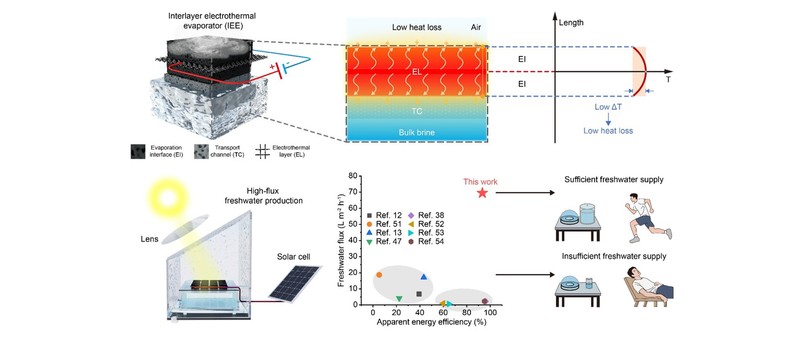
Recently,Prof. Lin Jiang’s research group from FUNSOM, Soochow University, made a major breakthrough. Their work, published in Nature Water, develop an interlayer electrothermal evaporator (IEE), which reduces heat loss and energy consumption by nearly two-thirds compared with conventional electrothermal evaporator. In this IEE configuration, the electrothermal layer is sandwiched between two evaporation interfaces with large pore-size microstructure. This design prioritizes the delivery of Joule heat to the evaporation interfaces for brine vaporization, forms a parabolic cross-sectional temperature profile, and avoids direct heat dissipation to the ambient environment and bulk brine, thereby lowering both heat loss and energy consumption. Furthermore, by harnessing the photothermal effect of solar energy, the solar-operated IEE delivers a freshwater flux of 69.46L·m-2·h-1 and an apparent energy utilization efficiency of 93.31%, establishing a practically feasible freshwater production capacity.
For outdoor applications, a portable freshwater production device is fabricated by integrating solar cells to supply green electricity and Fresnel lenses to concentrate solar irradiance. In outdoor tests, the solar-operated IEE rapidly produced 1.64 L of freshwater within 8 hours with an evaporation area of only 30.72 cm2, which is sufficient to meet the daily freshwater demand of an individual. This solar-operated IEE can treat sediment water, oily water, high-salinity wastewater and strongly acidic water, showing great flexibility in the treatment of diverse water sources. This work provides a viable design approach for green energy-driven and high-flux freshwater system across multiple scenarios, offering a promising solution to address freshwater scarcity in low- and middle-income regions and extreme environments.
Link to paper: https://www.nature.com/articles/s44221-026-00734-6
Title: Solar-operated interlayer electrothermal evaporator enabling instant high-flux freshwater production across multiple scenarios
Authors: He Yang, Jianyu Zuo, Yiming Zang, Bo Zhao, Chuanyou Xie, Chenyang Dai, Zhiqiang Liang, Meiwen Peng*, Yinghui Sun* & Lin Jiang*
Link to Prof. Lin Jiang’s group: https://nano.suda.edu.cn/00/90/c5716a131216/page.htm
Editor: Yajing Liu