



Perovskite/crystalline silicon tandem solar cells represent an important technological route for overcoming the efficiency limit of single-junction silicon photovoltaics and also show application potential in aerospace energy scenarios such as low-Earth-orbit satellites, space power stations, and space computing centers. Aerospace photovoltaics impose much stricter requirements on device lightweighting, radiation tolerance, and resistance to extreme temperature fluctuations than terrestrial applications. Perovskite materials combine a high power-to-mass ratio, low-temperature solution processability, and the potential for radiation-damage repair, giving perovskite/silicon tandems advantages in cost and power-to-mass ratio. For both terrestrial tandem devices and flexible/lightweight tandem devices for spacecraft, conformal coverage and charge extraction at the buried bottom interface remain common bottlenecks determining performance and reliability.
To improve sunlight utilization, silicon bottom cells generally adopt random pyramid texturing; however, the rough surface poses severe challenges for the buried bottom interface. A self-assembled monolayer (SAM) serving as the hole-transport layer must achieve uniform conformal coverage on the pyramid surface to effectively suppress interfacial recombination and ensure efficient hole extraction. Conventional SAM design involves a structural trade-off: increasing molecular conjugation favors enhanced conductivity and energy-level tuning, but tends to aggravate π–π stacking and molecular aggregation, leading to exposed pyramid tips, more interfacial defects, and intensified carrier recombination.
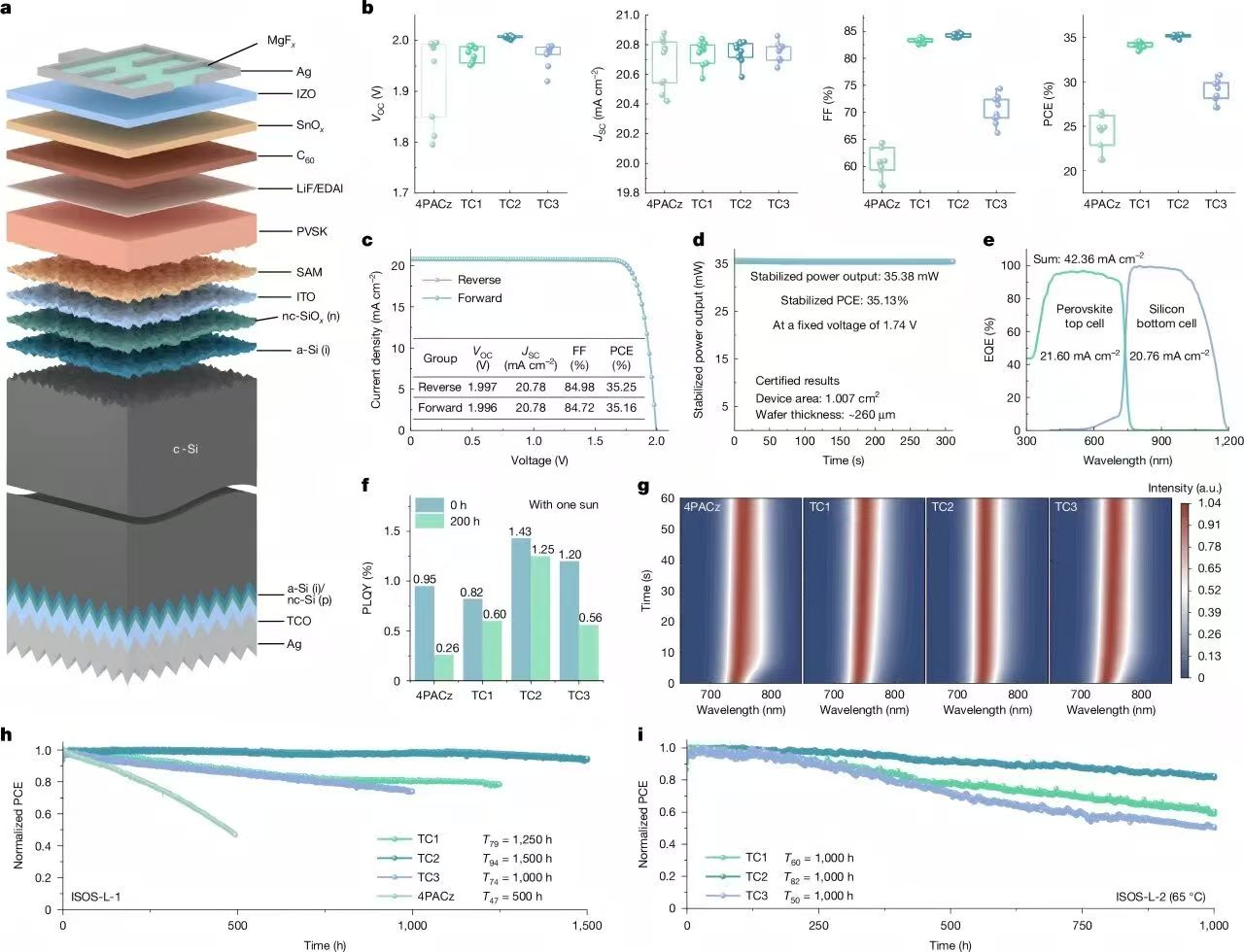
To address the above challenge, Prof. Xiaohong Zhang of the Institute of Functional Nano & Soft Materials (FUNSOM), Soochow University, and Prof. Jiang Liu’ of College of Energy, Soochow University, in collaboration with LONGi Green Energy Technology, Northwestern Polytechnical University, The Hong Kong Polytechnic University, CNPC Engineering Materials Research Institute, King Abdullah University of Science and Technology, The Chinese University of Hong Kong, Xi’an Jiaotong University, Suzhou National Laboratory, and other institutions, proposed a molecular design strategy based on sterically hindered nonplanar twisted conjugated structures. By introducing controlled intramolecular twisting, this strategy suppresses excessive molecular aggregation while maintaining charge-transport capability, enabling a highly ordered, conformally covering self-assembled monolayer (SAM) on rough pyramid-textured silicon substrates. The SAM achieved an average coverage of more than 80% on the pyramid surface, markedly superior to the control molecules.
The optimized hole-transport interface layer can tune the work function of indium tin oxide (ITO) and achieve energy-level alignment, thereby strengthening the built-in electric field and reducing the hole-injection barrier, which improves hole selectivity and extraction efficiency. In addition, this interface serves as a structural template for perovskite crystallization, improving film crystallinity, phase uniformity, and defect passivation. Based on this strategy, the team’s perovskite/crystalline silicon tandem cells achieved a third-party-certified stable power conversion efficiency of 35.1%.
This work further addresses the common challenge of rough-interface coverage at the molecular level and provides fundamental support for advancing next-generation ultrahigh-efficiency tandem photovoltaics from terrestrial to aerospace applications.
Link topaper: https://www.nature.com/articles/s41586-026-11226-8
Title: Conjugated-Regulated Self-Assembled Molecules for Tandem Solar Cells
Authors: Zheng Fang#, Zhijie Rao#, Chongtao Liu#, Lei Ding#, Anqi Lv#, Yuan Qin, Jingwei Xue, Vladyslav Hnapovskyi, Fuzong Xu, Tino Lukas, Zhaoyu Lou, Qingshui Zheng, Huimin Zhang, Yue Yin, Luxin Lu, Hongbo Mo, Fu Zhang, Yongcai He, Xixiang Xu, Martin Stolterfoht, Stefaan De Wolf, Long Jiang*, Bo He*, Jun Yin*, Kai Wang*, Jiang Liu*, Xiaohong Zhang*
Editor: Yajing Liu