On September 27, a delegation led by Professor Guo Yupeng, Associate Dean of the College of Chemistry at Jilin University, visited the College of Nano Science & Technology (CNST) at Soochow University for a collaborative exchange. The delegation held in-depth discussions with the CNST teaching team on the development of science and engineering undergraduate programs and the cultivation of top-notch talents. CNST attendees included Professor Wang Suidong, Associate Dean of Academic Affairs, Wang Lu, Dean Assistant, and faculty representatives Jiang Lin, Fan Jian, and Ma Yanyun.
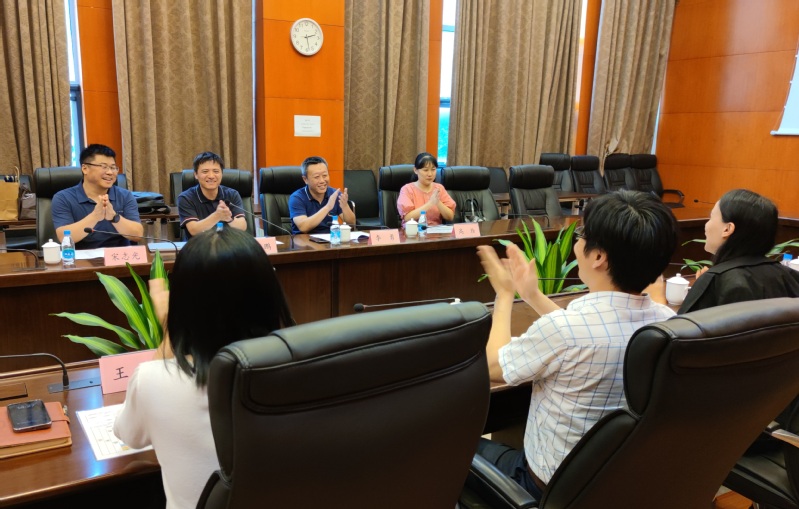
Professor Wang Suidong extended a warm welcometo the delegationon behalf of CNST. Wang Lu then gave a brief overview of CNST’s undergraduate program and disciplinary development. Professor Guo Yupeng expressed sincere gratitude for the warm reception. The two sides shared their latest practices in fostering top-notch undergraduate talents and engaged in substantive discussions on key challenges and priorities in undergraduate education, including faculty development, curriculum design, incentives for teaching reform, and policies regarding postgraduate recommendations and major transfers.
The College of Chemistry at Jilin University, established in 1952 under the prestigious “985 Project”, was among the first in China to offer doctoral programs in first-tier disciplines. Adhering to the philosophy of “solid foundation, broad scope”, the college adopts a parallelsmall-class teaching model, strengthens fundamentals in mathematics and science, and provides pathways for nurturing top-notch students. It emphasizes the integration of teaching and research, prioritizes core course development, and has extensive experience in securingnational and provincial teaching reform awards.
The College of Nano Science &Technology at Soochow University is a National Pilot College. Oriented toward the needs of national strategic emerging industries, it has developed a “Three Integration”training model—integrating education with research, integrating disciplines, and aligning with international standards—to cultivate internationally oriented research professionals. This exchange has provided fresh perspectives for the development of undergraduate programs in both institutions. Moving forward, the two sides will further deepen cooperation to jointly enhance the quality of undergraduate talent cultivation.
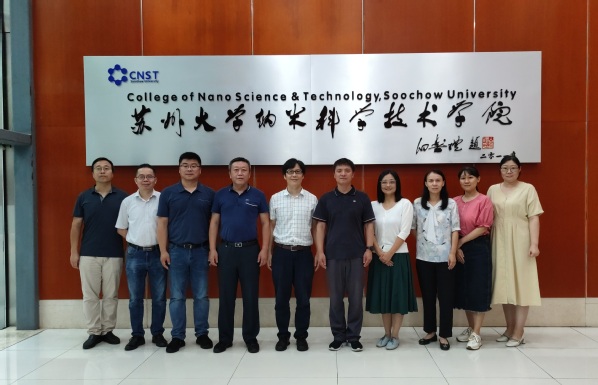
After the meeting, the delegation from Jilin University toured CNST’s Digital Teaching Laboratory and took a group photo with CNST faculty representatives.
Editor: Jin Wang


