



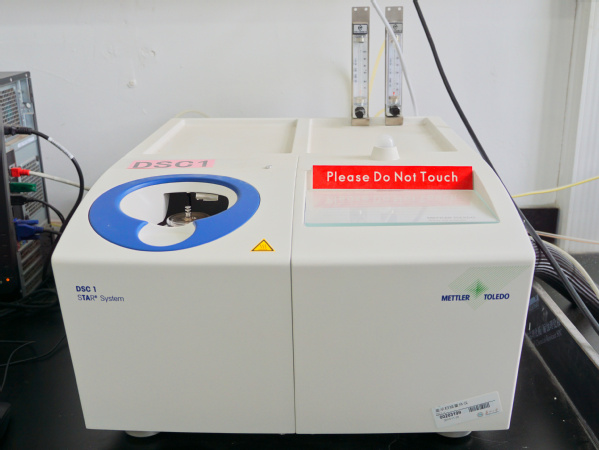
Description: Thermal analysis is the technique of measuring the physical properties of materials with temperature changes. DSC (Differential scaning calorimetry) is an instrument, which study of the physical quantities (Δ Q and Δ H) change of material under the temperature changes, namely through the change of the temperature, get the result of the power difference (heat flow rate) between the sample and reference.
name | Differential scaning calorimetry |
Model | DSC1 |
Manufacturer | METTLE TOLEDO |
Specifications | Temp. Range: …500 ℃ Temp. Accuracy: +/-0.1 ℃ Temp. Precision: +/-0.02 ℃ Heating Rate: 0.02…300 ℃/min; Ceramic Sensor: Exchangeable Number of thermal couples: 56 Calorimertric Sensitivity: 0.04 uW; Calorimertric Accuracy: +/-1 %; Calorimertric Reproducibility: +/-0.1%; Digital Resolution: 16,800,000 points; Signal Time Constant:1.7 s Signal/Noise Ratio: 17(70) sampling rate: 50 A/S |
Applications and Uses | In Differential Scanning Calorimetry, the heat flow in and out of a sample and a reference material is measured as a function of temperature as the sample is heated, cooled or held isothermally at constant temperature. DSC allows you to detect endothermic and exothermic effects, determine peak areas (transition and reaction enthalpies), determine temperatures that characterize a peak or other effects, and measure specific heat capacity. |
Contacts | Xiaodie He |
Contact number | 65884616 |
Edited by Xiao-Die He