



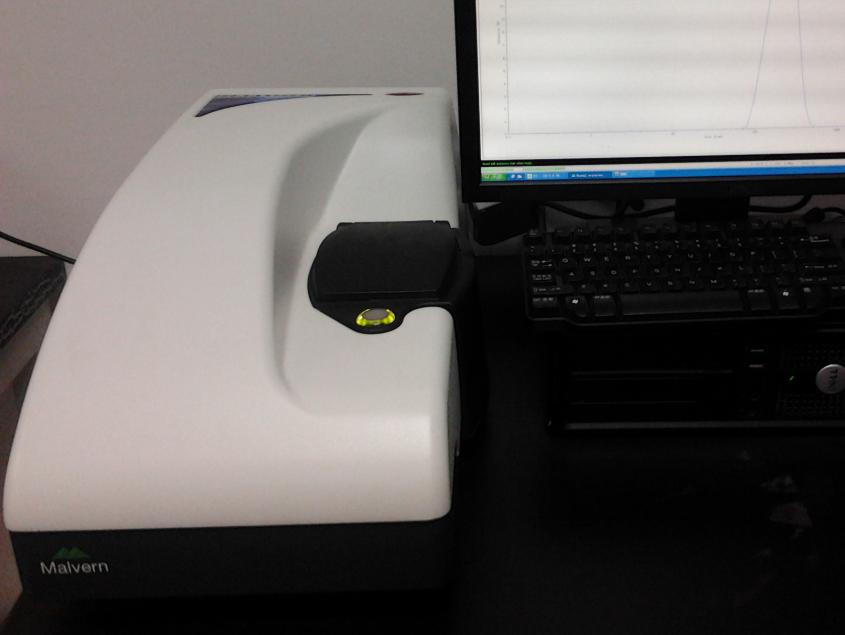
The Zetasizer Nano (Laser Particle Size and Zeta Potential Analyzer) is designed to provide exceptional sensitivity for the measurement of size, zeta potential and molecular weight. This is particularly important for applications where the sample is small, dilute or scatters poorly. Solutions of proteins are prime examples of this, and mean that the Zetasizer is an alternative to the use of capillary electrophoresis and isoelectric focussing for charge measurement.
Instrument name | Laser Particle Size and Zeta Potential Analyzer / Zetasizer Nano ZS90 |
Model number | Nano ZS90 |
Manufacturer | Malvern Instruments |
Specifications | 1. Size measurement from 0.3nm (diameter) to 5 microns using 90 degree scattering optics. 2. Zeta potential of proteins and particles from 3.8 nm up to 100 microns (diameter) using patented M3-PALS technology. 3. Molecular weight measurement down to 980 Da. 4. A Quality Factor gives confidence in the data. 5. The Expert advice report gives help to improve sample preparation or the measurement procedure. 6. 21CFR part 11 software option enables compliance with ER/ES. 7. Research software option gives access to further features and analysis algorithms for the light scattering specialist. 8. Automation of measurements using an autotitrator option. 9. Alternative laser, 50 mW at 532 nm for samples incompatible with the standard 633 nm laser fitted. 10. Optical filter option to improve measurements with fluorescent sample. 11. Temperature range extension option to 120 °C. |
Applications and Uses | The premium Zetasizer Nano system with the highest sensitivity and widest range of measured parameters. This is the world’s most popular system for the measurement of particle size and molecular size using Dynamic Light Scattering, zeta potential and electrophoretic mobility using Laser Doppler Microelectrophoresis, and molecular weight using Static Light Scattering. |
Contacts | Xiaofang Tan |
Contact number | 65884616 |
Editor: Xiaofang Tan