



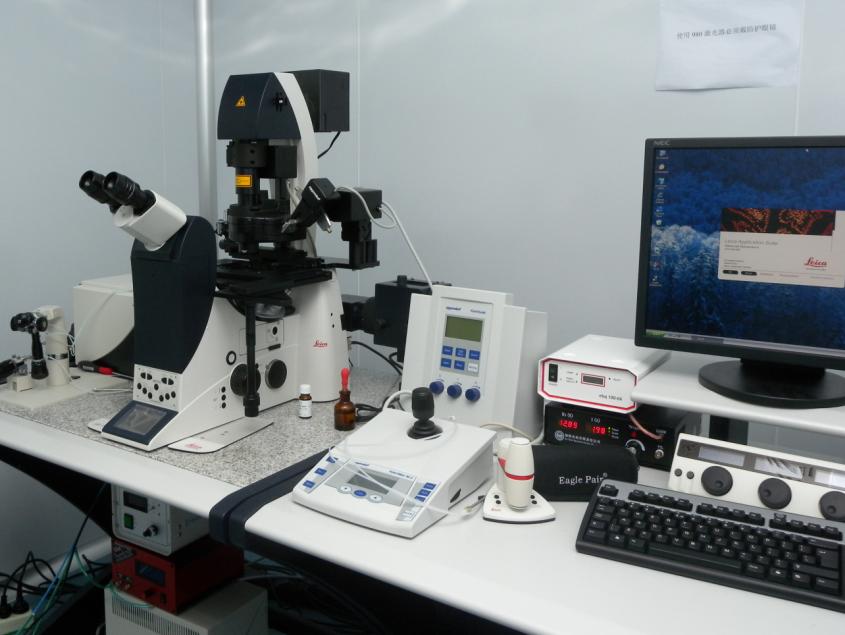
Confocal laser scanning microscopy (CLSM), is an optical imaging technique for increasing optical resolution and contrast of a micrograph by means of adding a spatial pinhole placed at the confocal plane of the lens to eliminate out-of-focus light. It enables the reconstruction of three-dimensional structures from sets of images obtained at different depths (a process known as optical sectioning) within a thick object. This technique has gained popularity in the scientific and industrial communities and typical applications are in life sciences, semiconductor inspection and materials science.
Instrument name | Laser-Scanning Confocal Microscopy |
Model number | TCS SP5 |
Manufacturer | Leica |
Specifications | The Leica SP5 confocal microscope at Adelaide Microscopy has seven, laser-generated, excitation wavelengths: 405 nm (pulsed), 458 nm, 478 nm, 488 nm, 496 nm, 514 nm, 561 nm and 633 nm. |
Applications and Uses | The Leica SP5 is an advanced scanned-laser confocal microscope that has five, high-sensitivity detectors for which the range of detected wavelengths can be accurately defined. This allows the emissions from fluorophores to be readily distinguished. The software supplied with the Leica SP5 can be used to process z-stacks to produce projection images and quantify co-localisation of fluorophores. When combined with the 3D analysis software at Adelaide Microscopy (AMIRA and analySIS) it becomes possible to visualise and quantify the full structure of a sample. |
Contacts | Xiangfang Tan |
Contact number | 65884616 |
xftan@suda.edu.cn |
Editor: Xiaofang Tan